
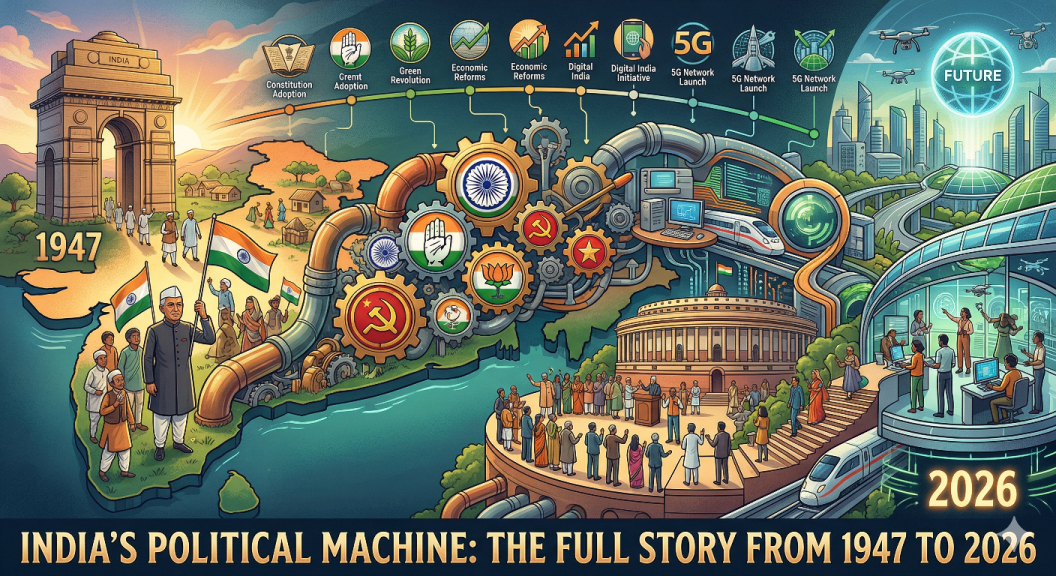
Chapter 1: The Foundation — What Nehru Built and Left Behind
Imagine it. August 15, 1947. A country of 350 million people that had never governed itself becomes free overnight. No roadmap. Massive poverty. Two hundred princely states. Religious riots killing hundreds of thousands. And one man — Jawaharlal Nehru — stands at the Red Fort and says, "Tryst with Destiny."
What Nehru built was genuinely impressive, and genuinely flawed. He was a Fabian socialist who believed the state should control the economy, that India needed planned industrial growth, that religion should stay out of politics. He laid down the institutions — the Supreme Court, the Election Commission, the IITs, the steel plants, a free press. These weren't small things. Most newly independent nations fell into dictatorship within years. India held elections in 1952 — with 176 million voters, most of whom had never voted in their lives, many illiterate. That was remarkable.
What Nehru Got Right
He kept the military out of politics. He kept elections free and fair. He built a secular Constitution. He kept India together despite partition trauma. He made education and science a priority. These foundations are why India is still a functioning democracy in 2026 when neighbors like Pakistan, Bangladesh, and Myanmar have all experienced coups and chaos.
But Here's Where the Problems Start
Nehru was also a man who believed in Congress's divine right to rule. He was deeply suspicious of opposition. He created the License Raj — a system where every business needed a government license, which meant businessmen needed to bribe politicians and bureaucrats just to exist. He laid the groundwork for India's most enduring disease: corruption-as-system.
His daughter Indira would inherit this Congress machine. And she would transform it into something much darker.
17
Years Nehru ruled India
3
Consecutive Congress majorities
363
Seats out of 489 in 1952
1
Party effectively ran India
The Congress monopoly on power was so complete that for the first 30 years of independence, India wasn't really a multi-party democracy — it was a one-party system with the appearance of opposition. The Congress was the state, and the state was Congress. This matters because it explains everything that came after.
Chapter 2: Indira Gandhi — The First Lesson in Authoritarian Populism
Indira Gandhi is the most important figure in understanding modern Indian politics. Not Nehru. Not Modi. Her. Because she was the first person to crack the code of how to win in India at any cost, and every politician since — left or right — has learned from her playbook.
She came to power in 1966, underestimated by everyone. Congress's old guard thought she was a puppet. They called her goongi gudiya — dumb doll. Within three years she had split the party, banished the old guard, and won a historic 1971 election on the slogan "Garibi Hatao" — Remove Poverty.
The Genius of "Garibi Hatao"
This was marketing genius, not policy. She didn't actually remove poverty. But she told the poor that she was their champion against the rich. She made the election a choice between her and "them" — the elites, the capitalists, the opposition. This was the first time an Indian politician ran a mass emotional campaign built on identity and grievance. Modi would perfect this same formula 43 years later.
The Emergency — When Democracy Almost Died
Then came the darkest chapter. In June 1975, a court ruled that Indira Gandhi had cheated in her own election. She should have resigned. Instead, she declared a national Emergency.
What happened next is still shocking. In a single night, opposition leaders were arrested in midnight raids. Newspapers were censored — electricity to their offices was cut off. Fundamental rights were suspended. Courts lost the power to issue habeas corpus. More than 100,000 people — politicians, journalists, activists, ordinary citizens — were thrown in jail. Atal Bihari Vajpayee, who would later become Prime Minister, was among those imprisoned. L.K. Advani too. Even George Fernandes.
"Indira is India and India is Indira." — D.K. Barooah, Congress President, 1975. Genuinely spoken. Not satire.
Her son Sanjay Gandhi became an extra-constitutional power center — accountable to nobody, feared by everyone. He ran forced sterilization campaigns on poor men. He bulldozed Delhi slums where people had lived for decades, in 24 hours. He controlled the press, the bureaucracy, the police. All without holding a single government post.
The Emergency Excesses (1975–77)
100,000+ political prisoners without trial. Mandatory forced vasectomies on poor men. Press censorship — all news had to be government-approved. Demolition of slums in Delhi overnight. Suspension of all fundamental rights. Constitutional amendments to put the PM above the law. Judiciary stripped of independence. Police given unlimited detention powers.
But Then — The Miracle
Here's the beautiful thing about democracy: Indira called elections in 1977, thinking she would win. She was certain. Her intelligence said the public loved her. She was wrong. The Indian voter — poor, illiterate, villager — turned up and voted her out. Completely. Even she and Sanjay lost their own seats.
This is the first great lesson of Indian politics: You can suppress everything except the vote. And when the vote comes, people remember.
Human Psychology Lesson #1
Indira overestimated fear and underestimated dignity. Poor, uneducated voters will tolerate much — but there is a line. When the government started sterilizing men's bodies and bulldozing their homes, they crossed a visceral line of bodily autonomy and personal safety. No amount of propaganda can override a threat people feel in their own flesh.
The Return and the Tragedy
Indira came back in 1980. Congress won. Because the Janata coalition that had replaced her was incompetent and fell apart. She was killed by her own Sikh bodyguards in October 1984, after she ordered the army into the Golden Temple (Operation Blue Star) to flush out Sikh separatists. It was a necessary but catastrophic decision — it turned her into a martyr and triggered a pogrom against Sikhs in Delhi where over 3,000 people were massacred. Congress workers led the mobs. The police stood down. It was one of the worst state-abetted communal massacres in post-independence India.
Her son Rajiv Gandhi won the 1984 election by the largest margin in Indian history — 411 seats — on a pure sympathy wave. And then proceeded to squander it.
Chapter 3: The Rotting — Congress's 40-Year Decline
Rajiv Gandhi was a pilot, not a politician. Charming, well-meaning, modern. He brought computers to India. He tried to modernize. And then the Bofors scandal broke.
Bofors — When the Music Stopped
In 1987, a Swedish radio station reported that the Indian government had paid bribes to middlemen to secure an artillery contract with Swedish arms company Bofors. The kickbacks involved over ₹64 crore. The finger pointed toward Rajiv Gandhi's friend Ottavio Quattrocchi, an Italian businessman who had deep access to the Prime Minister's household.
Rajiv denied everything. The government tried to suppress the investigation. But this was the moment Congress lost its moral authority. The party that had led India's freedom struggle — that had Mahatma Gandhi and Nehru in its DNA — was now caught with its hand in the weapons-buying jar. The garibi hatao crowd had become the corruption club.
Congress's Greatest Hits — Scandal Edition
Bofors (1987): Artillery kickbacks worth ₹64 crore. Rajiv Gandhi's image permanently tarnished.
Harshad Mehta Scam (1992): ₹4,025 crore stock market fraud. Exposed how easily banks and regulators could be gamed.
Hawala Scandal (1991–97): Illegal foreign exchange. Cross-party. But mainly Congress in the dock.
2G Spectrum Scam (2008): ₹1.76 lakh crore estimated loss. Telecom licenses sold below market value under UPA government's watch. A Raja, Telecom Minister, arrested.
Commonwealth Games Scam (2010): ₹70,000 crore. Stadiums leaked. Treadmills bought at 30x market price. Athletes' village embarrassing. India's prestige damaged globally.
Coalgate (2012): Coal blocks allocated to private companies without auctions. ₹1.86 lakh crore loss estimated by CAG.
The 2G scam alone — ₹1.76 lakh crore — was not just a number. It was proof that while common Indians stood in queues, their elected representatives were distributing the country's national resources to their friends. The rage this created was real, visceral, and justified.
The Silence at the Top
What made it worse was the Prime Minister. Manmohan Singh — an honest man, a brilliant economist — sat silently as his Cabinet colleagues looted. He later called the 2G allocation a "mistake." His silence was interpreted as complicity or weakness. In Indian politics, both are fatal. By 2013, a phrase had entered the public vocabulary: policy paralysis.
The Congress also had a dynastic problem it could never solve. The party existed to serve the Gandhi family. When Rahul Gandhi — Rajiv's son, Indira's grandson — was pushed forward as the future, the public wasn't buying it. He seemed unserious. He would disappear during elections and reappear for press conferences. The BJP's IT Cell gave him a nickname — "Pappu" — and it stuck. In the court of public opinion, image is everything.
Human Psychology Lesson #2
Dynasties survive on two fuels: performance and intimidation. When performance fails, only intimidation keeps them in power. Congress had neither by 2014. The Gandhi name, once magical, had become a liability — associated with scams, silence, and foreign vacations while India burned with frustration.
Chapter 4: The Birth of BJP — The Big Idea That Took 30 Years to Win
To understand BJP, you have to understand RSS. The Rashtriya Swayamsevak Sangh was founded in 1925 — before independence — by K.B. Hedgewar, a doctor from Nagpur who believed that Hindu culture needed to be organized and defended. RSS is not a political party. It's a social organization — a network of shakhas (daily drills, exercises, ideological discussions) spread across every town and village in India.
RSS gave BJP something no political party in India has ever had: a dedicated volunteer army with no electoral ambitions of their own. RSS workers don't want tickets or ministries. They want the ideology to succeed. This is a structural advantage that money alone cannot buy.
The Two Seats That Started a Revolution
In 1984, after Indira Gandhi's assassination, BJP won exactly 2 seats in the Lok Sabha. Two. Out of 543. It was a humiliation. But here's what happened next: instead of giving up, they went back to ideology.
L.K. Advani took over and made a decision that would change India forever. He connected BJP to the Ramjanmabhoomi movement — the demand to build a Hindu temple at Ayodhya, where a 16th-century mosque called the Babri Masjid stood on land that many Hindus believed was the birthplace of Lord Ram.
1984BJP wins 2 seats. Near-extinction event. Forces a complete strategic rethink.
1989Advani's Rath Yatra announced. BJP allies with VHP (Vishwa Hindu Parishad) on Ayodhya. Wins 85 seats in election.
1990Advani launches Rath Yatra — a political procession from Somnath to Ayodhya in a Toyota truck converted to look like a chariot. 10,000 km journey. Massive crowds. Communal tensions rise. He is arrested in Bihar. BJP withdraws support from V.P. Singh government, bringing it down.
1991BJP wins 120 seats. Fastest electoral rise in Indian democratic history.
1992December 6: Babri Masjid demolished by a mob of 150,000+ Hindu nationalist activists. Riots across India kill 2,000. BJP caught between responsibility and political gain.
1996BJP becomes single largest party. Vajpayee forms government — lasts 13 days. No coalition partners.
1998–99NDA government under Vajpayee. Nuclear tests (Pokhran-II). Full 5-year term. India runs a stable coalition.
The Strategic Genius of the Rath Yatra
Advani turned a religious dispute into political oxygen. The Babri Masjid issue had existed for decades but nobody had made it a mass political mobilization. The Rath Yatra physically traveled through villages, towns, and cities — building grass-roots enthusiasm and communal tension simultaneously. It turned BJP from an upper-caste Delhi party into a national Hindu mass movement. This was a masterclass in political branding using emotion, symbolism, and physical spectacle.
Chapter 5: Vajpayee — The Road Not Taken
Atal Bihari Vajpayee was the best Prime Minister India may have ever had, and nobody talks about him enough. He was from RSS, from BJP's ideological core — but he governed as a statesman. A poet. A coalition-builder who brought in Jayalalithaa, George Fernandes, Chandrababu Naidu — bitter rivals — and made it work for five years.
Under Vajpayee: India conducted nuclear tests (Pokhran-II, 1998) and stood firm against international pressure. He launched the Golden Quadrilateral highway project that physically transformed how goods and people moved across India. He opened the Lahore bus service to Pakistan and nearly made peace with Nawaz Sharif. He presided over the Kargil war and — crucially — held back from a full war after the 2001 Parliament attack. He showed that a Hindu nationalist party could govern a diverse democracy without dismantling it.
"We are Indians first and Hindus, Muslims, Christians, Sikhs afterwards." — Atal Bihari Vajpayee
Why He Lost in 2004
Then came the 2004 election and "India Shining." Vajpayee's team ran a campaign built on economic growth — GDP was rising, infrastructure was improving, India was at the world stage. The campaign slogan was India Shining. And the BJP lost. Badly.
Why? Because India Shining was the story of urban India, software India, shopping mall India. And the majority of voters lived in rural India, where the sunshine hadn't reached yet. Farmers were in debt. Unemployment was high in villages. The campaign was a perfect example of a party talking to itself rather than to its voters. The poor voted Congress back in.
Human Psychology Lesson #3
Voters don't vote based on aggregate national statistics. They vote based on what they feel in their own lives. "India is growing at 8% GDP" means nothing to a farmer whose crop failed and whose son can't find a job. You cannot win elections with macroeconomics. You win with micro-emotion.
Chapter 6: The Making of Modi — India's Most Polarizing Story
Narendra Damodardas Modi was born in 1950 in Vadnagar, a small town in Gujarat. His family was from the OBC (Other Backward Classes) — tea sellers. He left home at 17, allegedly worked at a tea stall, joined RSS as a pracharak (full-time volunteer), and worked his way up through the organization for decades. He had no family connections, no caste privilege in the traditional sense, no dynastic backing.
He became Gujarat's Chief Minister in 2001 — and then, in February 2002, happened the most contested event of his political life.
Gujarat 2002 — The Wound That Never Healed
On February 27, 2002, a train carrying Hindu pilgrims returning from Ayodhya was set on fire at Godhra station. 59 people died, many of them women and children. The attackers were Muslim. What followed was three days of anti-Muslim riots across Gujarat that killed approximately 1,000 to 2,000 people — official figure is 1,044, but independent estimates go higher. Muslim homes, businesses, and mosques were burned. Women were raped. Families were massacred. The police in many areas stood down.
The Supreme Court, human rights organizations, journalists, and foreign governments accused the Modi government of allowing — or even enabling — the riots. Modi denied it. His famous statement about the riots was that a car running over a puppy was unfortunate — widely seen as minimizing Muslim deaths. The US denied him a visa for years. The EU called for an investigation.
Gujarat Riots 2002 — What We Know
1,000–2,000 killed (official: 1,044). 150,000+ displaced. 27,000 arrested. 200 convicted in 2011 Supreme Court-monitored trial. Key accused including Babu Bajrangi (life sentence) caught on sting saying riots happened with "Sahib's" blessing. Supreme Court's SIT (Special Investigation Team) in 2012 gave Modi a clean chit, saying insufficient evidence to prosecute. But the SIT's own report noted a "failure of Gujarat state machinery." The debate on his personal culpability continues — legally cleared, politically haunted.
Here's the complicated truth: Modi was never convicted. The Supreme Court's SIT gave him a clean chit. But he also never showed genuine remorse for Muslim victims. When asked on TV if he regretted what happened, he said he felt bad like you do when a puppy gets run over. That answer defined how the country divided over him — those who felt it was insufficient for a Chief Minister of a state where Muslims were massacred on his watch, and those who felt the media was persecuting a Hindu leader.
The Gujarat Laboratory
Meanwhile, Modi governed Gujarat for 13 years and built an extraordinary record of industrial and infrastructure development. Gujarat's GDP grew. Electricity reached villages. Roads were built. Tata's Nano factory came to Gujarat after being thrown out of West Bengal. He was called the CEO Chief Minister. Business loved him. Investors came. The "Gujarat Model" became his calling card.
The Dual Image Strategy
Modi operated with two images simultaneously: the Hindu nationalist strongman who stood firm against "appeasement" — for the Hindu base — and the development-focused, business-friendly administrator — for the urban middle class and industrialists. This double image is very hard to defeat because different voters are responding to different things. The Congress was never able to land a clean attack because attacking one image strengthened him with the other audience.
Chapter 7: 2014 — The Most Brilliant Campaign in Indian History
The 2014 election was not just a political campaign. It was a marketing machine like India had never seen. And Narendra Modi was the product.
By 2013, the conditions were perfect for a challenger. The UPA government under Manmohan Singh was drowning in scam after scam — 2G, Coalgate, Commonwealth Games. Inflation was high. Rupee was falling. Youth unemployment was brutal. The media was in full anti-Congress mode. And there was a deep, inarticulate hunger for a "strong leader" — someone who would clean up, stand firm, make India matter.
The Architecture of Modi's Brand
BJP hired advertising agency APCO Worldwide and worked with PR firm The Public (US). They built Modi's image from scratch with astonishing discipline:
- The Chaiwalla narrative — poor boy who sold tea, now running for PM. Against the dynasty that had never worked a day. Identity relatability at its most powerful.
- The 3D hologram rallies — Modi appeared simultaneously in hundreds of locations. First time in world political history. Made him seem everywhere, superhuman.
- Exclusive interviews with friendly media. Total control of the narrative. No press conferences where he might be cornered.
- The digital army — BJP's IT Cell under Amit Shah built tens of thousands of WhatsApp groups, Facebook pages, Twitter handles. They set trending hashtags. They buried negative stories under floods of positive content.
- The slogan: "Ab ki baar, Modi sarkaar" — This time, Modi government. Simple, rhythmic, powerful. Kids were chanting it. It became a cultural meme.
- The promise: "Achhe Din aayenge" — Good days will come. Vague enough to mean everything to everyone. Nobody could prove it wrong before the election.
The Amit Shah Factor
The underrated genius behind the 2014 victory was Amit Shah, not Modi. Shah is India's greatest election strategist. He divided India's 543 constituencies into micro-segments by caste, religion, economic class, and local issue. He assigned booth-level managers — one person responsible for 900–1,200 voters. BJP contested 428 seats and built specific coalition strategies for each. This micro-level organization is what wins in India's first-past-the-post system, where 30% of votes can give you 60% of seats if strategically distributed.
The Result
BJP won 282 seats. A single-party majority for the first time since Rajiv Gandhi's 1984 sympathy wave. The NDA coalition had 336. Congress was reduced to 44 seats — unable to even form the official opposition. India had chosen its most decisive verdict in 30 years.
Human Psychology Lesson #4
The anti-incumbency vote is the most powerful force in Indian elections. Modi didn't just win because people loved him — many voted against the scam-tainted, paralyzed, arrogant Congress. When voters are angry enough, they will vote for an unknown devil over a known failure. BJP understood this and made sure every piece of their campaign reminded voters of Congress's failures first, and Modi's promise second. Negative emotions drive turnout harder than positive ones.
Chapter 8: The Black Book of BJP — What They Got Wrong
This section is not for BJP-bashing. It's for strategic truth-telling. Because any honest case study must look at both the brilliance and the darkness. And BJP, in power since 2014, has accumulated a significant list of both.
Demonetization — The Great Disaster
November 8, 2016. 8 PM. Modi appeared on national TV and announced that as of midnight, all ₹500 and ₹1,000 notes — 86% of India's cash in circulation — were no longer legal tender. You had 50 days to exchange them.
The stated goal: destroy "black money," catch corruption, push India toward digital payments. The actual result: chaos. Hundreds of millions of Indians, most of whom operated in cash, were suddenly stranded. Farmers couldn't buy seeds. Daily laborers lost work because their employers had no valid cash to pay them. ATM queues stretched for miles. Over 100 people died standing in bank lines. Small businesses collapsed.
Demonetization — The Numbers
99.3% of demonetized notes returned to banks — meaning almost no "black money" was destroyed (it all got laundered back). GDP growth fell sharply. Informal economy — which employed 90% of India — contracted badly. Economists across the world called it a "self-inflicted wound." RBI eventually confirmed there was no significant destruction of black money. Yet Modi's approval rating barely moved because it was packaged as a sacrifice against "corrupt rich people."
The Electoral Bonds Scam
In 2018, the Modi government introduced Electoral Bonds — anonymous donations to political parties routed through SBI bank. The official pitch: transparency and legality in political funding. The actual architecture: companies could donate any amount anonymously, government could secretly track every donor through hidden codes, but the public couldn't know who funded which party.
The Supreme Court in February 2024 struck down the entire scheme as unconstitutional — a violation of citizens' right to information. When data was finally released, it revealed that companies under ED or CBI investigation had donated massively to BJP just before their cases were dropped or settled. The pattern was damning: pay the ruling party, get relief from state agencies.
Electoral Bonds — The Pattern
Total bonds sold: ₹16,518 crore. BJP received ~57% — ₹9,407 crore. Investigation: companies facing ED/CBI raids donated to BJP. Example: Sarath Chandra Reddy arrested by ED in November 2022, donated ₹55 crore to BJP shortly before and after. DLF donated ₹1.7 billion to BJP 2019–22. Numerous other patterns of donation-followed-by-relief. Supreme Court: scheme violated constitutional rights. Opposition parties also benefited — but at far smaller scale.
Using Agencies as Weapons
Perhaps the most damaging allegation against the BJP government is the use of CBI, ED, and Income Tax as tools to target political opponents. The pattern is consistent enough to be documented:
- 25 opposition leaders under investigation joined BJP between 2014–2024. Of these, 23 saw their cases slow down or close after joining.
- Delhi Chief Minister Arvind Kejriwal was arrested by ED in March 2024 — weeks before the general election. He governed from jail for months.
- Jharkhand Chief Minister Hemant Soren was arrested by ED in January 2024 — also before elections. He was later released when his party won.
- The pattern critics call "washing machine politics" — a politician joins BJP and their corruption charges miraculously vanish in the wash.
The "Washing Machine" Dynamic
This is not unique to BJP — Congress used CBI similarly against opponents, leading to the CBI being called a "caged parrot" by the Supreme Court in 2013. But the scale under BJP has been unprecedented. When central investigative agencies become partisan tools, they lose institutional credibility, which damages the entire justice system long after any single government is gone.
The Disinformation Machine
BJP's IT Cell, headed by Amit Malviya, runs what independent researchers describe as the largest political disinformation operation in India's history. The documented operations include:
- 150,000 social media workers spreading content via WhatsApp groups built on caste and religion lines.
- Fake news deliberately created and distributed — Amit Shah admitted in a party meeting in 2017 that the IT Cell could spread "any message, true or fake."
- AI-generated deepfakes of opposition leaders saying things they never said.
- Systematic Muslim-hate content (anti-jihad tropes) shared in encrypted WhatsApp groups, allowing plausible deniability while stoking communal tension.
- 700+ Facebook pages taken down by Meta for "coordinated inauthentic behavior" connected to BJP supporters.
"We should be capable of delivering any message to the public, whether sweet or sour, true or fake." — Amit Shah, BJP President, party meeting in Rajasthan, September 2018
Press Freedom Collapse
India fell to 161 out of 180 in the 2023 World Press Freedom Index. Under BJP rule, several major media groups came under the ownership of Modi-friendly businessmen. TV channels that were once critical became promoters. The phrase "Godi Media" (lapdog media) entered common usage — referring to channels that lie on Modi's lap like a pet. Independent journalists have faced IT raids, defamation cases, and harassment. The sedition law was used to silence critics.
The Minority Question
The treatment of Muslims under BJP governments has been the most internationally criticized aspect. Mob lynchings of Muslims by "cow vigilantes" increased sharply between 2014–2024. Bulldozers were used to demolish Muslim homes as extrajudicial punishment — "bulldozer justice" became a political phrase of pride for BJP ministers. Hijab bans in schools. CAA (Citizenship Amendment Act) that excluded Muslim refugees. NRC fears. Mosque-temple disputes multiplied. India's global ranking on minority rights dropped consistently.
Human Psychology Lesson #5
The "out-group" strategy is as old as politics. Creating a common enemy — a "them" against "us" — is the single most reliable way to consolidate a majority. For BJP, Muslims serve as the persistent "other" that keeps Hindus emotionally united despite their massive internal differences of caste, language, and economic class. The fear of a Muslim-dominated India (an absurdity — Muslims are 14% of population) has been systematically amplified through WhatsApp networks for a decade. When people are afraid, they vote together.
Chapter 9: Modi 2.0 and 3.0 — Power Consolidation and the Unexpected Setback
In 2019, BJP won 303 seats — more than 2014. The margin of victory was stunning. The Pulwama terror attack (40 CRPF soldiers killed) followed by Balakot air strikes against Pakistan just months before the election gave Modi a national security surge. Voters rewarded strength. Congress's Rahul Gandhi ran a campaign that included poverty relief promises (NYAY scheme) — a better platform, actually — but couldn't overcome the wave.
In Modi's second term, the moves were bolder and more ideological:
- Article 370 revoked (2019): Jammu & Kashmir's special status removed. Statehood revoked, split into two UTs. Massive troop deployment. Internet cut for months. A historic BJP promise fulfilled. Constitutionally contested, politically triumphant.
- CAA passed (2019): Citizenship Amendment Act — fast track for Hindu, Sikh, Christian, Buddhist refugees from Pakistan, Bangladesh, Afghanistan — but not Muslim. Largest protests India had seen since anti-Emergency movement erupted. Shaheen Bagh became a symbol.
- Ram Mandir inauguration (January 2024): The temple finally built at Ayodhya after the Babri Masjid demolition in 1992 and Supreme Court verdict in 2019. Modi performed the consecration ceremony. Massive spectacle. 84% of India watched on TV. For BJP's Hindu nationalist base, this was the culmination of a 40-year dream.
2024 — The Shock
BJP entered 2024 with stunning confidence. They announced a target of 370+ seats (above the 2/3 majority mark). They called it "400 paar." The Ram Mandir consecration just months before seemed to guarantee a historic landslide.
And then — they lost their own majority. BJP won 240 seats — down 63 from 2019. Not enough to govern alone. The NDA coalition still won enough to form government, but Modi needed allies who now had leverage they'd never had before. The INDIA alliance (Congress, SP, TMC, AAP, etc.) won 234 seats — a far better opposition showing than anyone predicted.
Why 2024 Went Wrong for BJP
Multiple factors converged: Youth unemployment at record highs — India has millions of graduates who can't find jobs. NEET paper leak scandal — the national medical entrance exam was compromised, affecting millions of students. Caste politics in UP — Samajwadi Party under Akhilesh Yadav ran a brilliant PDA (Pichda, Dalit, Alpsankhyak) coalition. The Opposition INDIA alliance provided a credible alternative for the first time. The Ram Mandir peak had already passed its emotional high. And in Bihar/UP, reservation anxiety among OBCs and Dalits was weaponized against BJP. The public mood had shifted from aspirational to anxious.
Chapter 10: The Human Psychology of Indian Elections — The Full Playbook
This is the chapter that matters most for strategic understanding. How do politicians actually win in India? What are the psychological levers? This is not about ideology — it's about human nature.
The 7 Weapons of Indian Political Psychology
1. Identity Before Interest
In India, most voters vote their identity — caste, religion, language — before they vote their economic interest. A poor Yadav in UP will vote for a Yadav candidate who has done nothing for him before voting for a non-Yadav candidate who offers better governance. Why? Because group membership feels like safety. The world is uncertain. Your caste is permanent. Politicians exploit this by becoming the protector of the group identity, not the problem-solver.
2. Fear Beats Hope
In every study of Indian elections, fear-based messaging outperforms hope-based messaging. "Your temple will be taken away" mobilizes faster than "I will build better hospitals." The amygdala — the brain's threat-detection center — responds faster than the prefrontal cortex. Fear drives same-day action. Hope requires trust, which takes years to build.
3. The Big Man Theory
India's political culture is built on the neta (leader) as the savior. Not systems. Not institutions. The Man. Nehru. Indira. Vajpayee. Modi. The voter doesn't want accountable institutions — they want a strong father figure who will personally protect them. This is why Congress collapsed after Nehru died — the party's institutions were weak. Modi understood this and built the entire BJP around his personal image, not the party's.
4. The Performance of Performance
Governing well and being seen to govern well are two different skills. Modi is a master of the second. His schemes have excellent names — PM Ujjwala Yojana (cooking gas), Jan Dhan (bank accounts), PM Awas (housing), Swachh Bharat (clean India). Whether or not they fully work, the announcement, branding, and personal delivery theater creates the feeling of action. Voters reward visible effort — real or theatrical.
5. The Narrative Monopoly
Control what people talk about and you control what they vote about. If the election is about national security, BJP wins. If it's about unemployment, they lose. The entire media strategy — the IT Cell, the Godi Media, the WhatsApp floods — is designed to ensure the election is fought on BJP's chosen terrain. In 2024, SP managed to shift the narrative in UP to caste reservation — and that's why BJP lost badly there.
6. Cash, Kind, and Welfare
This is dirty but real. Across parties, election seasons mean cash distribution — ₹500 notes in envelopes, liquor, sarees, rice, pressure cookers. Surveys estimate that in state elections, 20–40% of voters receive some direct material benefit. Voters in the poorest states are most susceptible. But — and this is crucial — welfare in the form of LPG cylinders, free rations (PM Modi's free ration scheme covers 80 crore people), and toilet construction is also a form of electoral cash. The line between governance and vote-buying is deliberately blurred.
7. Anti-Incumbency as Physics
After a few years in power, any government accumulates enemies — those whose lands were acquired, whose business was ignored, whose relative was not given a ticket. This physics is unavoidable. The only escape is to keep offering new hope before the disappointment calcifies. Modi's genius has been to launch a new scheme every few months — keeping the promise of future good days alive even as past promises remain partially unfulfilled.
The Ultimate Political Formula — Observed Across 79 Years
Strong personal leader + Simple emotional narrative (us vs. them) + Organized ground presence + Control of information environment + Welfare drip (enough to feel, not enough to satisfy) + Structural organizational advantage (RSS for BJP, caste networks for regional parties) = Electoral dominance. The formula is not ideology-specific. Congress used it with Indira's "Garibi Hatao." Mamata uses it with "Bengali pride." Modi uses it with "Hindu resurgence." The wrapper changes. The formula is the same.
Chapter 11: The Broken System — Flaws Written Into the Architecture
These are not BJP's flaws or Congress's flaws. These are structural problems baked into how India's democracy was built and how it has evolved. They allow bad politics to succeed and make good governance difficult.
Flaw 1: First-Past-The-Post in a Multi-Party System
India uses FPTP (winner takes all). In a constituency with 10 candidates, you can win with 22% of votes. This means parties can win massive parliamentary majorities with 37% of votes nationally — which is exactly what BJP did in 2014. The 63% who voted against them are barely represented. This creates manufactured majorities that don't reflect national will.
Flaw 2: Criminalization of Politics
In 2024, 46% of newly elected MPs had criminal cases filed against them — including cases of murder, kidnapping, and rape. Why does this happen? Because criminals have money, muscle, and caste networks. Parties know voters elect them. And once elected, an MP is almost impossible to remove regardless of what crimes they commit. The system has no mechanism to stop this cycle.
Flaw 3: Black Money and Campaign Finance
Declared election expenditure limits are a joke. A Lok Sabha candidate is allowed to spend ₹95 lakh. Studies suggest actual spending is 10–50x higher. Where does it come from? Black money, corporate donations, extortion. The electoral bonds scheme was an attempt to formalize this — but it became a tool of coercion. Without clean campaign finance, every elected government owes favors it must repay.
Flaw 4: The Governor Problem
State Governors are appointed by the Central Government. Constitutionally they should be neutral — in practice they are partisan weapons. When an opposition party wins a state, the Governor can delay summoning the legislature, refuse to administer oath to the CM, or create procedural obstacles. This has happened repeatedly in Maharashtra, Tamil Nadu, Kerala, Bengal. The Governor is the Central Government's tool to destabilize opposition states.
Flaw 5: The Courts Are Slow, Not Always Independent
India has 50 million pending court cases. Justice takes decades. Powerful politicians can delay trials indefinitely. The Supreme Court has sometimes been accused of proximity to the ruling government — during the Emergency, most judges bent to Indira's will (one famous exception: Justice H.R. Khanna, who dissented and never became Chief Justice as a result). Courts give clean chits to politicians because evidence is genuinely complex — or because institutional courage is rare.
Flaw 6: Media Capture
Whoever controls the biggest media companies controls the national narrative. Under BJP, key TV channels came under ownership of Modi-friendly businessmen. The result is a news ecosystem where the ruling party's narrative dominates prime time, while independent reporting is squeezed to digital platforms, which reach a much smaller audience. A government that controls both the bureaucracy and the narrative is very hard to hold accountable.
Chapter 12: The Full Scandals List — Everyone's Dirty Hands
This is the uncomfortable chapter that India doesn't like to reckon with honestly. Because the public narrative tends to be: either Congress is the party of scams, or BJP is the party of corruption. The truth is messier. Every major party has looted. The scale, the era, and the methods differ. The essential human flaw — power corrupts — does not.
Congress Scandal Hall of Shame
1948Jeep Scam — India's first independence-era scam. Jeeps purchased for the army at inflated prices through a London-based agent. V.K. Krishna Menon implicated. India's very first corruption scandal as a free nation.
1987Bofors Scam — ₹64 crore kickbacks in Swedish artillery deal. Rajiv Gandhi government accused. Key accused Ottavio Quattrocchi fled India. Case dragged for 30 years, never concluded.
1992Harshad Mehta Securities Scam — ₹4,025 crore. Stock market manipulated using bank receipts. Mehta had famous photos with PM Narasimha Rao, whom he claimed he gave ₹1 crore in cash.
20082G Spectrum Scam — ₹1.76 lakh crore estimated loss. A. Raja, UPA Telecom Minister, allegedly sold spectrum licenses at 2001 prices in 2008. Over 100 licenses later cancelled by Supreme Court.
2010Commonwealth Games Scam — ₹70,000 crore. Suresh Kalmadi, Congress MP, convicted. India globally embarrassed by unfinished venues and quality disasters.
2012Coalgate — ₹1.86 lakh crore. Coal blocks allocated by PM Manmohan Singh's own ministry (he held the coal portfolio) without competitive auction. 214 blocks, systematic undervaluation.
BJP Scandal Hall of Shame
2016Demonetization — Official target failed. 99.3% of notes returned. Economy damaged. Agricultural sector crushed. MSMEs destroyed. Unofficial estimate: 150+ deaths in bank queues.
2016Rafale Deal — India purchased 36 Rafale fighter jets from France at a price critics said was 3x the original quoted price. Dassault Aviation was allegedly required to partner with Anil Ambani's company (no aerospace experience) as an offset partner. Supreme Court cleared the deal; opposition called it crony capitalism at India's expense.
2023Adani Group — Hindenburg Research report accused Adani Group (closely associated with Modi) of stock manipulation and accounting fraud. Group lost $150 billion in market value. No Indian regulatory action followed. US indicted Gautam Adani on bribery charges in 2024 related to solar energy contracts — charges later dropped.
2024Electoral Bonds — Struck down by SC as unconstitutional. Data revealed systematic pattern of companies under investigation donating to BJP then receiving relief. Total BJP share: ₹9,407 crore.
2024NEET Paper Leak — National medical entrance exam leaked days before it was given. 67 students scored perfect scores — statistically near-impossible. Massive student protests. NTA chief removed.
Chapter 13: India in 2026 — Where Things Stand
As of April 2026, Narendra Modi is Prime Minister for a third term — but with a coalition dependency he never had before. BJP governs 20 of India's 36 states and union territories. The INDIA opposition alliance has fractured — AAP and Congress are fighting each other in Delhi. Kejriwal is back as Delhi CM after winning the 2025 elections. Mamata Banerjee remains TMC's stronghold in Bengal.
The economy has contradictions. India is the world's 5th largest economy and is set to be 3rd in the next decade. The GDP growth story is real — 7-8% annual growth, infrastructure investment unlike anything in India's history. But youth unemployment remains a crisis. The informal sector hasn't recovered from COVID and demonetization. Inequality is growing — India's billionaires' wealth grew massively while median real wages stagnated.
5th
GDP rank globally, 2026
161st
Press Freedom Index rank
96th
Corruption Perceptions (of 180)
46%
MPs with criminal cases (2024)
The BJP's challenge now is the same it has always been: promises have a shelf life. "Achhe Din" of 2014 cannot run for a third election in 2029. The Ram Mandir is built — now what? The new promise is Viksit Bharat (Developed India) by 2047 — India's 100th independence anniversary. Will the youth, drowning in unemployment and competitive exam anxiety, wait 21 more years?
The opposition's problem is no single figure has Modi's charisma. Rahul Gandhi has matured significantly and ran a real 2024 campaign — but he is still dogged by "Pappu" perception among swing voters. Regional leaders — Akhilesh Yadav, Stalin, Mamata — are powerful in their own states but cannot build a national narrative.
Chapter 14: The Masterclass — What Actually Wins in India
Seven decades of evidence points to the same truth again and again. Here is what wins Indian elections — distilled without ideology, without party bias, purely as observable pattern.
The 10 Principles of Indian Political Power
1. Be the story, not the policy. Voters remember how you made them feel, not what your manifesto said. Modi's "chaiwalla to Prime Minister" story was worth more than any policy paper. Indira's "garibi hatao" was a feeling, not an economic plan.
2. Build ground, not just social media. BJP's RSS network, SP's caste networks, Mamata's poriborton committees — physical human networks beat digital campaigns at the last mile. India is still 65% rural. WhatsApp reaches them, but the local neta's relationship seals the vote.
3. Control the conversation before the election. The election is won months before voting day. Whoever sets the dominant narrative — national security, caste reservation, Hindu pride, development — wins. Let your opponent set the narrative and you're already losing.
4. Never underestimate the poor voter. The poor vote in higher proportions than the rich. They are observant, strategic, and not easily fooled — but they can be swayed by identity politics and immediate material benefit. Ignore them at your peril (see BJP's 2024 setback in UP).
5. Coalition arithmetic before ideology. India's electoral math often means winning with 30–35% of the vote. Caste arithmetic matters more than opinion polls. Amit Shah built every state strategy from caste data. Akhilesh Yadav built PDA. The winner builds the widest tent before the battle, not during.
6. One face, one message. Single-leader campaigns dramatically outperform multi-leader platforms in India. Modi had a face. UPA 2014 had no face. BJP 2014 was a presidential campaign. India's voters find unity in a single trustworthy (or inspiring) face.
7. Deliver the last mile, then own it. Jan Dhan accounts, LPG cylinders, free rations, toilet construction — these are not just governance. They are political relationships. Every beneficiary is a potential voter. The delivery must be visible, attributed to the leader personally, and accompanied by his/her image.
8. Control fear, don't just promise hope. Fear is faster than hope. The threat of losing something activates people faster than the promise of gaining something. BJP built "Hindu khatre mein hai" — Hindus are in danger — and turned it into a permanent mobilization engine. Every politician who has built a lasting coalition has a "threat to us" narrative.
9. The media environment is the battlefield. You can win the argument and lose the war if your opponent controls more screens. Invest in media relationships, social media infrastructure, and friendly journalists early. Congress's collapse was partly a story of losing the narrative entirely by 2013.
10. Human weakness is the raw material. Pride, fear, belonging, resentment, hope, greed — these are not bugs in the voter. They are the operating system. Every successful political campaign is fundamentally a human psychology operation. The leader who understands that is not manipulating voters — they are meeting voters where they actually are. The line between manipulation and resonance is thin, and the most honest politicians acknowledge it.
"In a democracy, people get the government they deserve." — Alexis de Tocqueville, 1835. Still the most honest thing anyone has ever said about democracy.
The Final Truth — India's Democracy, Imperfect and Alive
After 79 years, here's what the evidence shows: India's democracy is deeply flawed, regularly abused, frequently bought, manipulated, and run by people with their own interests — but it is alive. The Emergency ended because people voted it out. Congress's corruption ended (for a time) because people voted it out. BJP's overconfidence in 2024 was corrected — by voters.
Every few years, the voter — the aam aadmi, the farmer, the auto driver, the domestic worker — walks into a booth and pulls a lever. And sometimes they surprise everyone. They surprised Indira in 1977. They surprised Vajpayee in 2004. They surprised Modi in 2024.
This is not a heroic story. It is a story with dark chapters, betrayals, and ongoing failures. But it is also a story of 1.4 billion people trying to govern themselves — in the most complicated, diverse, unequal, spiritual, cynical, hopeful country on earth.
And as of 2026, they're still trying.
That, for what it's worth, is something.
This case study is written purely for strategic and educational understanding. All facts and scandals cited are drawn from documented public record, court findings, investigative journalism, academic research, and official government data. The goal is not to damage any party or individual's reputation, but to provide honest analysis of how Indian politics operates — the good, the bad, and the structurally broken — for those who wish to understand power, psychology, and democracy in the world's largest nation.
Sources: Britannica, Wikipedia (India/BJP/Congress articles), Carnegie Endowment, Council on Foreign Relations, The Wire, Al Jazeera Investigations, TIME Magazine, Rest of World, Mozilla Foundation Research, GIJN, Pulitzer Center, ORF, Project Syndicate, Oxford Academic, and multiple academic papers on Indian electoral behavior and political psychology. Research conducted April 2026.